Wednesday, February 22, 2017

"Dazzle Them with the Basics" or Trouble with Tralfamadorians: My Thoughts on "Arrival"

"Dazzle Them with the Basics" or Trouble with Tralfamadorians: My Thoughts on Arrival


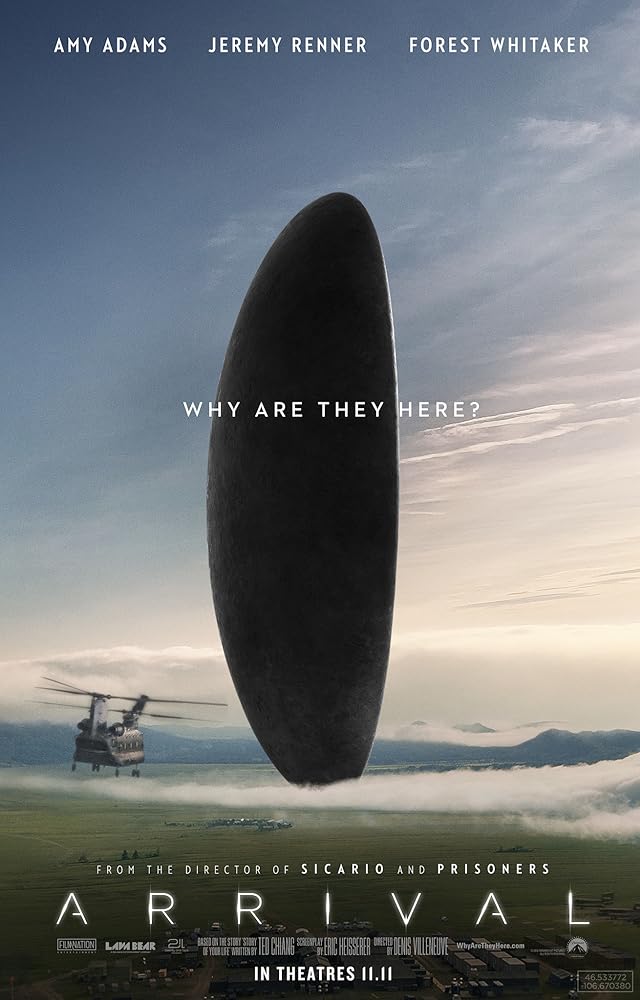
Image taken from IMDB


 In 2012, I studied to teach English as a foreign language. Near the end of the course, we had a segment on culture where we participated in a group exercise. Group 1 were assigned to play tourists trying to buy sandals on a ten minute layover. Group 2 were English-speaking locals who A) viewed contact with the ground as a form of spiritual purity, and B) had no equivalent of a question form. I was in Group 3, which tried to interpret what was going on. Neither of the first two groups knew what the other one had been assigned (and us in Group 3 were ignorant of both).

As you can imagine, a bizarre scene followed, where many assumptions were made. During the debriefing after, we discussed how culture intersects with language. I thought back on this exercise when I was watching the 2016 film Arrival, which hearkens back to the roots of sci-fi film by focusing on the philosophical implications of an alien encounter rather than fast ships and loud explosions. You can tell a lot of love and creativity went into this project. It's well shot, well acted, suspenseful. And it works...mostly.

First, the positive. The aliens are the breakout stars of this movie. Unearthly, mysterious, and inscrutable, they still manage to be immensely likable. I found myself rooting for them (and at one point fearing for their safety) as much as I did for the human characters. Considering they have no faces and barely anything resembling dialog, on top of looking like something out of a Lovecraftian nightmare, that's quite a movie-making accomplishment.

It's refreshing to see an alien movie that focuses on the alienness--that feeling of smallness and helplessness that comes with encountering something totally beyond the frame of human experience. The aliens in Arrival aren't hostile; they don't want to eat us or blow up our planet. All the conflict in the story derives from the aliens' otherness: the struggle to comprehend what may not be comprehensible and the accompanying descent into fear and paranoia.

There's good suspense leading up the the reveal of the aliens. The movie takes its time even revealing what the ship looks like, and when you finally do see it...The design and cinematography made me really wish I had seen this movie on the big screen. The characters are in the dark as well, right up to the point where they take their stomach-churning first step onto the gravity-defying ship. It's implied the last guy to talk to the aliens went mad, and you can believe it.

Anything involving the aliens and their esoteric language is not screen time wasted.

Our human characters are compelling as well. Amy Adams carries the story with her intelligence, her tenacity, and her vulnerability. She can be afraid and overwhelmed, but she also takes calculated risks--such as removing her hazmat suit so that the aliens ("Heptapods" because of their seven legs) can see her in the flesh. She's professional, but she also gives pushback to her superiors from the military when their methods get in the way of her doing her job.

Jeremy Renner also gives a solid performance as a skeptical scientist in spite of an opening line that makes him seem weirdly antagonistic. He quickly warms up to Adams' character and clearly has her back throughout the story. I like seeing a male character who gets over prejudice without turning into a whining toddler. Reasonable men exist, Hollywood.

Unfortunately, there were also some downsides for me. I'll look at the less spoiler-y first.

As you can gather from the trailer, a big theme in this movie is language, namely how our language determines the way we think and ultimately the choices we make. So I was looking forward to seeing what techniques an expert linguist like Louise (Adams) would bring to the table to communicate with these extra-dimensional beings. And I got...stuff I learned in my three-month TESOL certification course.

I with the film had given its audience more credit. I felt sorry for Adams' character--having to explain everything to these morons.

"She wrote her name on a whiteboard and pointed to herself??? What wizardry is this? No one's ever done that before!"

Are you kidding me? That is literally the first thing anyone would do when trying to breach the language barrier. I guess "Me Tarzan, you Jane" is also too deep for these guys. At one point, Louise describes her own writing as "dazzle them with the basics." I feel you, girl.

Yet at another point the military criticize Louise for teaching the Heptapods simple nouns and verbs instead of immediately trying to learn their intentions toward Earth. In response, she takes the question "What is your purpose on earth?" and explains all the assumptions you need to make before that sentence makes sense. For example, do the aliens even have questions? How do they distinguish between you singular and you plural (or are they a hive mind, which no one suggests)? Do they have intentions, or are they creatures of instinct?

But wouldn't most people realize that's not a question you can ask or answer within a few weeks of studying a language? Everyone knows that you spend the first hour of Spanish 101 learning how to introduce yourself. And that's learning an Earth language as an Earthling.

In fact, Louise undersells the problem. As an experiment, I tried translating "What is your purpose on earth?" into Japanese, a language I know okay. I came up with,

地球に来たの目標は何ですか?

Which isn't perfect, but it gets the job done. But obviously I've studied Japanese too long because I didn't realize for a while that I had completely bypassed one of Louise's big problems. In Japanese, you don't need the "you." "Coming to earth purpose is what" is a perfectly natural sentence. But it's a classic example of Japanese ambiguity that drives Americans up the wall. Apparently Japanese is weirder than Heptapod.

Another moment that made me wan to throw my computer across the room came when they figure out the Heptapods' language is only written, with no aural component. Again, the characters act like this is some mind-blowing concept we've never seen before (though thankfully it's a brief scene). Which would be insulting enough, even if they didn't spend a huge chunk of the movie TALKING ABOUT CHINA.

CHINA.

I realize it's not exactly the same thing because obviously you can speak Mandarin, but one of the most widely spoken languages in the world uses a writing system based on idea, not sound. You can't sound out a new character in Chinese like you can in English with d-o-g = dog. If you've never seen 犬 before, you will have no idea what it sounds like and probably no idea what it means unless someone tells you.

Also, we have sign language, which is neither written, heard, nor spoken.

Point being: This isn't new stuff. Earth languages are weird.

I'm disappointed in the lack of imagination in Arrival. There are so many ways to explore language in film, but in spite of some clever moments, Arrival felt very pedestrian.


***FROM HERE ON IN THERE BE SPOILERS***


I can't really discuss the ending of the movie without getting into spoiler territory, so if you want to see the movie as a totally blank slate, skip the rest of the review.

In addition to language, another theme of Arrival is nonlinear time. The Heptapods perceive time as all happening at once and it's this perspective they want to give to humans by sharing their language.

Okay, so far so good. But I feel like the way they develop this theme works better as a shoutout to movie buffs than in service to the movie's story. The most clever use of time and language plays with the language of film. For example, if we see one scene cut before another scene, we as audience tend to assume those scenes are meant to be in chronological order and that scene 1 will help us interpret scene 2--but that's not always the case. Sometimes movies need to show us events out of order.

Another example of film language is showing a scene out of context and then cutting to a character's reaction. Are we meant to see this as a memory? A vision? Mind reading? Without dialog, we can make guesses, but we don't know for sure.

Arrival uses nonlinear time to play with film language and give us a believable twist that fits with the setup of the film.

However, while the idea is good, the execution falls flat from a story perspective. The tragic backstory (or "front" story) they give the main character is beyond cliche. Literally think of the first sad thing that comes to mind, and that's probably it. The backstory scenes feel too sappy for the rest of the movie, and we don't need them to sympathize with the main character.

Nonlinear perspective also is key to solving the growing international conflict on earth. But the way Louise uses it...doesn't hold up to scrutiny. Briefly, Louise gains access to some highly private family information and uses it to talk down a hostile world leader. But if I were about to drop a nuke and some stranger called me and told me something only I should know, my reaction would be less "Yay world peace!" and more "Go to hell."

I wish Louise's plan were the culmination of facts we had seen throughout the film, occurring at both past and future spots in the timeline, instead of information that's dumped on her literally as she's putting the plan into action.

But the biggest issue surrounding the film's use of nonlinear time is one of character. And I've been putting off mentioning this for several hundred words now, but it's time to face the elephant in the room. Aliens and nonlinear time has been done before. Famously.

The moment you hear those concepts together, you can't help but think of Kurt Vonnegut's anti-war novel Slaughterhouse 5. But that book takes a slightly different angle from Arrival. Where in the film the aliens are altruistic beings capable of self-sacrifice who work towards a mutually beneficial arrangement with humans, Vonnegut's Tralfamadorians are assholes.

The Trafamadorians have no concept of death, so they have no regard for life. Everyone's both dead and alive to them. They feel no personal responsibility because everything that happens, happens. Their motto, which rings like a dirge throughout the book, is, "So it goes." Dresden gets firebombed. So it goes. Just accept it. The only expression of will for the Tralfamadorians is to gather as many happy moments as possible because they'll be experiencing them on endless replay for the rest of eternity.

Arrival didn't have to take the same route as Slaughterhouse 5. They could have portrayed multiple branching futures, or even multiple pasts. The Heptapods might not have a concept of death, since at one point they use the term "death process" instead of "dead," indicating that death is something they go through, not a final state. It's something to think about. But they appear to have some regard for human life and pursue their goals in a way that brings about peace on earth, so they're not heartless.

Yet the Tralfamadorian philosophy creeps in, not with the aliens but with our main character. Near the end of the film, Louise gains the enlightened perspective of the Heptapods, and it's implied (at least according to another character) that she makes a choice: to let another person die an early painful death. Louise reasons that the good times she will spend with that person outweigh the grief of parting--which after all is not truly the end.

But Louise is the only human who perceives time this way. For everyone else, dead is dead.

You could argue that Louise's choice gave this person a happy, albeit brief existence they wouldn't have had otherwise. But I was raised Christian, and I've heard that argument before. That's the line of reasoning that says God is perfectly within his rights to predestine us to hell. He created the world, he brought us into the world, and he can do with us as he pleases. It's a monstrous argument to defend a monstrous being.

By the end of the movie, Louise has become very Tralfamadorian. Collecting happy moments is all that matters. Other humans' agency? Not so much. Which would be fine if the film portrayed it as a morally ambiguous choice, or as a descent into fatalism. But the film ends with this "cherish the moment" uplifting tone that seems less appropriate the longer your think about the implications.

In conclusion, I think the value of Arrival comes down to whether you are a fan of film or a fan of story. If you're a movie buff, this film succeeds. But if you like good stories...

While writing this review, I began to wonder if all media takes place in nonlinear time. From my perspective, aren't the events of Arrival always happening? Don't I say, "Louise watches the alien arrival on the TV" and "Louise steps onto the space ship" as if those are both present, when in fact they are days apart for the character? Yet, when I actually read a book or watch a movie I have to experience it linearly the way the characters do.

 My journey with any work is linear, but it's a spiral. Each time I come back to a book or movie, I see something new, building on all my previous experiences with it. I wonder what I'll think the next time I watch Arrival.

Saturday, January 28, 2017

Blog Hiatus and Pics from Japan

So last semester I had to create a blog on Wordpress as part of my homework. That's why I didn't make any updates to this one. However, I did want to get at least one post up during January since who knows what I'll be busy with once the semester really starts.

As people on Facebook already know, I spent ten days in Japan over break. And I was worried about so many things about this trip. One thing did really disappoint me, but in the end I don't think it was something I could have changed without being a fundamentally different person. Overall I saw many beautiful sights and had many cherished reunions with old friends.

Here are some of the best pictures I took on the trip.

A friendly robot at the ghibli museum

Kanazawa castle

Okonomiyaki

The Atomic bomb dome in the snow

Miyajima Torii

Snow at the top of Mt. Misen

Todaiji (home of the giant Buddha statue) in Nara

Monday, August 22, 2016

KKM Chapter 1 historical note

I only have one page today. But it took me a long time to translate the text. :P Paragraphs about Japanese history are a bit more of a job than manga dialog. But anyway...


1神の島:厳島の今昔
1 Island of God: Itsukushima’s past and present

神話や伝説が息づく島、厳島
Island of living myths and legends, Itsukushima

松島、天橋立とともに日本三景のひとつである安芸の宮島。厳島とも呼ばれ、雄大な自然と神秘的な佇まいに、古来、神が宿るとしてさまざまな神話や伝説が語り継がれてきた。天然記念物と弥山原始林と海上に浮かぶ厳島神社世界文化遺産に登録され、世界中から観光客が訪ねている。

Along with Matsushima and Amanohashidate, Aki Miyajima is counted as one of Japan’s three beauty spots. With majestic nature and mysterious appearances, Miyajima (also called Itsukushima) is known as the dwelling place of the gods, and many myths and legends have been handed down since ancient times. The natural monument Mt. Misen and the floating Itsukushima shrine have been registered as world cultural heritage sites, and people from all over the world come to visit.

標高的533m、宮島で最も高い弥山は、806年に弘法大師・空海が開創。1200年余り、山岳信仰の霊峰として平清盛などに崇められてきた。"日本の三景の真価の頂上の眺めにあり"と言われ、原始林が史跡、寺社など多くの見どころ。

At a height of 533 meters, Misen is Miyajima’s tallest mountain. In 806 BCE the monk Kobodaishi (Kuukai) founded a shrine at its summit. Around 1200 BCE, the site became revered as a sacred mountain by the likes of Taira no Kiyomori. It’s been said, “The true value of this one of Japan’s beauty spots is the view from the summit,” and its many highlights include virgin forest, shrines and temples, and historic landmarks.

推古の天皇即位の年(593年)に創建された厳島神社は、神様と人間界と結ぶ"接点"と言われる場所。仁安3年(1168年)、平清盛によって造営された社殿は、神殿造りの様式を取り入れつつ海の上という自然条件も克服したなくみな造り。800年以上の歴史の中で、機度も災害にあいながらも、ほぼ創建当時も見ることができる。シンボル的存在の大鳥居は満潮時には堂々と海面に浮かび、干潮時には干潟に穏やかな雰囲をまとって佇んでいる。

Established in 593 BCE, the year of Empress Suiko’s coronation, Itsukushima is said to be the point of contact between humans and gods. In Year 3 of the Nin’an period, the shrine pavilions established by Taira no Kiyomori, incorporating the style of the main rooms, were a triumph over nature, an ingenious structure “on top of the sea.” During its post-1800 history, even while meeting disasters time and again, Itsukushima has managed to appear nearly the same as at its founding. The symbolic presence of the Torii gate floats boldly on the surface of the sea at high tide, and at low tide stands on the tidelands cloaked in an atmosphere of calmness.

Saturday, August 20, 2016

On "Fairness"

One of the top ten sermon cliches is "fairness." As soon, as I say that word, you know what I mean. It always comes up with the theodicy portion of whatever the topic is. Something will come up like death, or earthquakes, or world hunger. For the handful of people who don't know what theodicy means, the pastor will ask how an omnipotent, omniscient, omnibenevolent God let bad things happen. The pastor will adopt a whiny voice and ask, "But why isn't the world fair?"

Next, the pastor will grin. Because he thinks his whiny voice was amusing. "Well," he'll say. "I'm very glad the world isn't fair. I'm very glad God isn't fair. Because if God was fair He would have every right to send me to hell for my sins."

The idea is that God isn't the one mucking things up. It's us humans who created the whole shitstorm by eating from the wrong tree, and we've carried on the legacy ever since.

Just today I realized how bizarre this argument is. As Inigo Montoya would say, "You keep using that word. I do not think it means what you think it means." Not only is human evil a bad answer to the question of why God allows evil in the world, I don't think it's even answering the same question.

Imagine you see someone molesting a child. Would it really comfort you to think, "Yes, that adult's actions are bad. But what God wants to do to that little child is an infinity of times worse"?

Think about it.

Pointing to some terrible suffering, and saying God could do so much worse (in fact his nature demands it) is the opposite of comforting. This goes beyond God causing the evil in the world or passively allowing evil to happen. It portrays a God who looks down on the petty misery we unleash on each other and goes, "Hah! Amateurs!"

Now, I guess you could say "The point is he could send us all to hell and he doesn't! He just sends most of us. See how nice God can be?"

If he still had to torture himself, does that mean he's a masochist?

Also, how is this not, "Stop crying or I'll give you something to cry about?"

I'm even sure this particular theodicy is in the bible. That human suffering is no problem because we're all sinful anyway and deserve worse. Actually, it does sound a lot like Paul and his whole predestination rant.

Interestingly, there are characters in the Bible who ask almost this exact question of theodicy. In fact, the disciples actually make it easy on Jesus by assuming from the get go that sin has to be involved in some way.

Here's John 9:1-5 (NIV version)

As he went along, he saw a man blind from birth. His disciples asked him, “Rabbi, who sinned, this man or his parents, that he was born blind?”
“Neither this man nor his parents sinned,” said Jesus, “but this happened so that the works of God might be displayed in him. As long as it is day, we must do the works of him who sent me. Night is coming, when no one can work. While I am in the world, I am the light of the world.”
 After saying this, he spit on the ground, made some mud with the saliva, and put it on the man’s eyes. “Go,” he told him, “wash in the Pool of Siloam” (this word means “Sent”). So the man went and washed, and came home seeing.

Huh. 

It's almost as if Jesus doesn't think human sin caused this man's disability. Almost like his reaction is compassion instead of self-righteousness. Like, instead of explaining away another person's suffering, his job is to help. And he's got a limited window to heal people while he's on earth, but he's going to do as much as he can.

If someone asks me, "If God is good why is there evil and death and sickness in the world? How is that fair? " my answer is, "I don't know. You're right. It's not fair. Let's try to make it better."

Or maybe God just smited that guy so He could look really awesome healing him later. In that case we can all just sit on our butts and debate theology.

Wednesday, August 10, 2016

Orthodoxy Chapter 2: The Maniac


Chesterton begins this chapter by talking about “complete self confidence” as a moral failing. He describes an incident where a friend’s innocent remark prompted him to give the following response.

Shall I tell you where the men are who believe most in themselves? For I can tell you. I know of men who believe in themselves more colossally than Napoleon or Caesar. I know where flames the fixed star of certainty and success. I can guide you to the thrones of the Superman. The men who really believe in themselves are all in lunatic asylums. (7-8)

I like to think of Chesterton literally saying all this exactly as it is written down, complete with Shakespeare reference and transposed sentence structure, while the publisher’s eyes roll back in his skull and he begins wondering what urgent engagement of his can possibly take place within the next twenty minutes.

Actually the publisher does ask the pertinent question of whether all people everywhere who believe in themselves are actually in lunatic asylums. And Chesterton agrees that, sure, some have escaped that fate. But they’re all bores, debtors, failures, drunks and general “rotters.” (9) He urges his friend to consider humans in terms of his “business sense” instead of this “ugly individualistic philosophy” (9) (btw real charming move there, Chesterton). And for the rest of the paragraph he pretty much goes on to say that believing in yourself is the most sinful and stupidest thing you can possibly do.

(At the end of the conversation, the friend supposedly asks Chesterton “If a man is not to believe in himself, in what is he to believe?” which I don’t think happened. I think the friend said something more like, “Um….I just remembered my wife is in the hospital and I have an urgent meeting with my boss and my kid’s soccer game is happening literally right now.”)

Now, Chesterton muddies the waters a bit when he brings up “complete self confidence” for about a sentence, and then goes back to talking about regular old “believing in oneself.” So I’m not whether he’s telling us to avoid self confidence that goes to an unrealistic extreme, or if we’re just supposed to be doubting ourselves all the time.

I agree that “believe in yourself” doesn’t really mean anything when you don’t have the skill to back it up. On the other hand, I think negative thinking can really bite you in the butt and make you screw up even when things were going fine. So it’s better to focus on what you can do.

But this anecdote is more of a lead up to the chapter than a main point. Chesterton goes on to talk about the necessity of accepting original sin as a starting point for talking about the human condition. He goes on for a couple of paragraphs about how totally obvious sin is and how everyone has always believed in it since forever, without ever really giving us a definition for sin, or naming any theologians (besides one counter example).

The one sinful act he does mention is “skinning a cat” for fun (10) so I guess Chesterton is just talking about how humans tend to do really bad stuff for no reason. People doing bad stuff is important to talk about, but Chesterton glosses over the different interpretations people have to explain why people are this way. It’s all “sin.” His argument here is pretty much that either people are sinful, people are crazy, or you’re in denial.

Now, Plato also worked on teasing out the nuance between knowledge and virtue in his dialog Meno. So looking at the intersection between mental health and good behavior is nothing new. However, I am a little disappointed in the lack of nuance Chesterton gives in his view of sin. System and culture, two huge factors for human behavior, get left out entirely.

For example, we would judge the skinning cat man less harshly if he was hungry and elated at the idea of eating some fresh kitty (although the cat might not agree). He’s still bad, but if he’s a homeless guy with few food options, he’s not acting for the same reasons as a sociopath who tortures animals for fun. In another case, the skinning cat man might see a Christian father spanking a six-month-old and be totally shocked. In his culture, animal cruelty is fine, but hitting babies no matter what the context is evil.

Not that either of these two cases take out the idea of sin. They just locate sin away from the heart of the individual (as some inexplicable force that makes humans mean) and into the world in general as a thing that makes human relationships go wrong and demands an extra portion of virtue to combat. The problem with the skinning cat analogy is it’s too “other.” No one reading Chesterton actually likes skinning cats. So it’s very easy to skim the paragraph and think, “Oh, yes. Sin is a big problem…For other people.”

In the next few paragraphs, Chesterton takes up the idea of madness, saying that madness might look interesting from the outside but from the inside it’s very dull:

A blind man may be picturesque; but it requires two eyes to see the picture. (9)

(I got news for you, Chesterton, blind people are generally pretty sane and have average artistic sensibility in concepts other than sight. But carry on.)

The idea of madness being reminds me most of the memoir I Never Promised You a Rose Garden, about a teenage girl with Schizophrenia. In many ways, the world in her head is fantastical, with gods and visions and beautiful landscapes. But it’s fundamentally a world of punishments and traps that she built to mirror the real world. When she begins to recover, she is amazed by the beauty of the real world.

Chesterton also defends the use of an every-person narrator in literature—a relatable hero who experiences weird shit (Labyrinth, anyone?). I think this is kind of a matter of taste, though. I’m not a huge fan of sociopathic narrators, but I do like ones that are a bit quirky, like Cassandra in I Capture the Castle.

Over pages 10 and 11, Chesterton defends imagination as a normal part of human life. He rejects the idea that imagination and mysticism cause people to go crazy. This is an argument people still need to hear today. Going back to I Never Promised You a Rose Garden, the author says in the afterward,

The promulgation of this myth makes creative people reluctant to seek needed therapy because they fear their gifts will vanish. It also makes mentally ill people fear invoking what creative forces they have for fear of deepening their already substantial anguish.

Both Joanne Greenburg and Chesterton agree that art is not the cause of madness; instead it can be a powerful tool in the recovery of mental health (although Greenburg emphasizes the communal aspect of art more).

Chesterton does sprinkle some weird comments in these pages.  Such as “Odd people are always complaining of the dullness of life” (10) (it depends on what kind of odd people), “poets do not go mad, but chess players [and mathematicians] do,” (10) (what do you have against chess???) and, “only one great English poet went mad” (11). With the benefit of Google, Chesterton might have heard of Sir Thomas Wyatt or Lord Byron.

In conclusion, Chesterton makes artistic sensibility, which enjoys the world, opposed to logical or scientific thought, which analyzes the world.

The poet only asks to get his head into the heavens. It is the logician who seeks to get the heavens into his head. And it is his head that splits. (11)

Chesterton spends the rest of page 12 and 13 explaining that an overabundance of reason is what makes people go mad, because then people don’t have any imagination or humility. Which seems very odd to me. I really don’t think you have to lose your imagination to be a good scientist. Hell, it’s because people see world as strange and wonderful that they want to study it. As Richard Dawkins said,

Isn't it sad to go to your grave without ever wondering why you were born? Who, with such a thought, would not spring from bed, eager to resume discovering the world and rejoicing to be part of it?

But in Chesterton’s world a skeptic and atheist can’t feel the joy of being alive. It only took me two minutes on Google to find that quote.

In pages 14 and 15, Chesterton goes on to describe a kind of person who’s arguments make perfect logical sense in that they are perfectly consistent but which fail to encompass the complexities of reality.

“A small circle is quite as infinite as a large circle; but…it is not so large. In the same way the insane explanation is quite as complete as the sane one, but it is not so large.” (14)

Which actually does sound like a real type of person. I’ve listened to debates with the presuppositionalist theologian Sye Ten Bruggencate, for example. His schtick is that if you just assume God is always right and humans are just too stupid and sinful to understand, then everything makes sense. Why is there evil in the world? Phhh. Don’t question God. That’s sinful. Just agree that God’s plan is perfect, and everything by definition will be perfect.

However, while these types of jerks usually pay lip service to logic, I don’t think they abound more within scientific communities necessarily. Sure, they will assume they alone are totally rational while everyone else is influenced by emotion, while simultaneously being totally blind to their own raging ego. But that just sounds more like your run-of-the-mill asshole than some scientist run amok. Assholes use science as an excuse to justify their own whims. They’re not actually interested in discovering everything. Being a scientist actually requires a certain amount of humility. You have to be willing to put aside your prejudices and listen to the facts, even when they prove you wrong.

I find it ironic that at this point the ultra orthodox Chesterton is babbling on about modern science, while I’m just shrugging and going “People are assholes. Didn’t you notice?” It’s sort of like we switched positions.

Then Chesterton spends the rest of the chapter talking about the materialist worldview in a way that makes it clear he has never talked to any real materialists. He keeps referencing Joseph McCabe but never actually quotes him. (Google tells me McCabe had a strange obsession with “ether.”) His main argument is that materialists are all crazy (“I am not now discussing the relation of these creeds to truth, but…their relation to health” (18)) and a purely material universe is boring (“if the cosmos of the materialist is the real cosmos, it is not much of a cosmos” (18)).

The interesting thing is that a lot of the materialists I’ve listened to or read have pretty open minds about the supernatural. It’s not that “they are not allowed to admit into [their] spotless machine the slightest speck of spiritualism or miracle” (19). More: “OMG You have a real speck of miracle????? Let me see it! Let’s run tests on it! Stop the presses! I’m so freakin’ excited cuz this changes everything!!!!!” As the skeptic blogger Seth Andrews is fond of saying, “Show me the evidence.” Many people adopt a materialistic worldview not because they don’t think the supernatural could possibly exist, but simply because it’s a waste of time to look for supernatural solutions to problems when material causes and solutions are so much more logical and useful.

Later on the same page, Chesterton sells his own religion short with a weird analogy.

Spiritual doctrines do not actually limit the mind as do materialistic denials. Even if I believe in immortality I need not think about it. But if I disbelieve in immortality I must not think about it. (19)

This is diametrically opposed to everything I heard in church growing up. What comes after death was the entire driving force behind every sermon and Sunday school lesson. We kids were obsessed with getting out of hell and viewed it as our first duty to force people have the kind of faith that would save them as well. We very much “need” to think about it.

And for the next few pages Chesterton goes on about fatalism and determinism and how you can’t possibly have free with without an omnipotent god who foresees everything because that makes a ton of sense…Supposedly materialist beliefs,

…right or wrong, they gradually destroy…humanity; I do not mean only kindness, I mean hope, courage, poetry, initiative, all that is human. (19)

(Did Chesterton just admit he thinks the materialists might be right?)

Basically Chesterton waxes dull on the evil of materialism for another couple of pages. And then he gets into “Eastern” symbolism taken up by “many moderns:” the circle, which Chesterton calls “the very symbol of this ultimate nullity.” (22) For example, the serpent eating its tail (which supposedly the moderns use to represent infinity) is “a degraded animal who destroys even himself.” (22)

Quick! To the Wikipedia!

The snake eating its tail is Ouroboros, and represents self-reflexivity, introspection, and cyclicality. It originally came from Egypt, but has been used in Indian and Greek philosophy, and Norse legends, as well as Gnosticism and Alchemy. Not strictly an “Eastern” symbol, and not only a symbol of infinity.

But we can be sure that circles are an entirely pagan symbol and completely unfit for Christian thought. As a debased sultan once wrote in his barbaric rhymes,

That circle which appeared—in my poor style—
Like a reflected radiance in Thee,
After my eyes had studied it awhile,
Within, and in its own hue, seemed to be
Tinted with the figure of a Man…

Whoops. That was Dante Alighieri, Paradise canto 33 lines 127-131.

And here in a nutshell is the problem with using symbols. Symbols carry meaning because of their interpretation. Chesterton’s earlier analogy of a closed mind being like a circle works because he takes a neutral shape and draws a comparison that clarifies his. He doesn’t just say, “madmen are like circles, and by the way circles are Eastern and eeeeevil!” like he’s doing here.

And then the rest of the chapter is all about the importance of mysticism, which we already read about in the introduction, with some added stuff about embracing contradictions. It’s kind of thrown in at the end of the chapter, so I won’t go into it in too much detail.

The ordinary man…has always cared more for truth than for consistency. If he saw two truths that seemed to contradict each other, he would take the two truths and the contradiction along with them. (23)

My best guess is that Chesterton is talking about the variety of lived experience here. Like, “I’m straight and attracted to men, but my friend is bi and in a relationship with a woman. That’s weird to me but I’m not going to deny her relationship because the evidence is right in front of me.”

And he closes with some more “I don’t think you know how symbols work.”

“Buddhism is centripetal, but Christianity is centrifugal.” (23) I think on the first day of classes Chesterton stumbled into a physics class while thinking it was Religion 101 and never figured out his mistake. Also centrifugal force is just applied inertia.

And, “The cross…can extend its four arms for ever without altering its shape. Because it has a paradox in its centre it can grow without changing…the cross opens its arms to the four winds; it is a signpost for free travelers.” (24)

You know what the cross is a symbol of? DON’T FUCK WITH ROME.